A healthcare communication expert goes to hospital…
Earlier this year I had major surgery. Two weeks before the procedure I met with my surgeon who talked me through a document about how to prepare for surgery and how to manage recovery. It helped me plan for the next few months of my life. What I didn’t expect, however, was that I’d be provided with more information that differed significantly from what I’d originally been told. Of course plans can change across the course of care, but this was static, standardised written information that was not being specifically produced for me, but rather a collection of pre-determined directions for how to manage recovery.
In all, I received four different discharge documents which had conflicting information on them, including the original document provided by the surgeon. Another had the surgeon’s name on it, as if it were his documentation, but it was so different from what had been given to me pre-operatively, it was either very out of date or actually a generic document with his name added. The other two were automated nursing discharges and contained the same information in different layouts.
The differences were potentially problematic in some cases, with conflicting information about when I could lift items, when I could drive, how I should interpret post-operative symptoms to decide whether I needed to attend hospital. There were also issues around clarity and detail of the information in the documents, with issues relating to design, like font size, and to language choice, such as overly technical language.
Given what I do, I spent some of my recovery period preparing an analysis of these documents to provide to the surgeon at my 6 week post-operative check up. It was a fairly straight-forward comparison of the documents as well as some analysis of language choices to help design future documentation.
Here’s a snippet comparing these, with some simple recommendations about what to change int he final column.
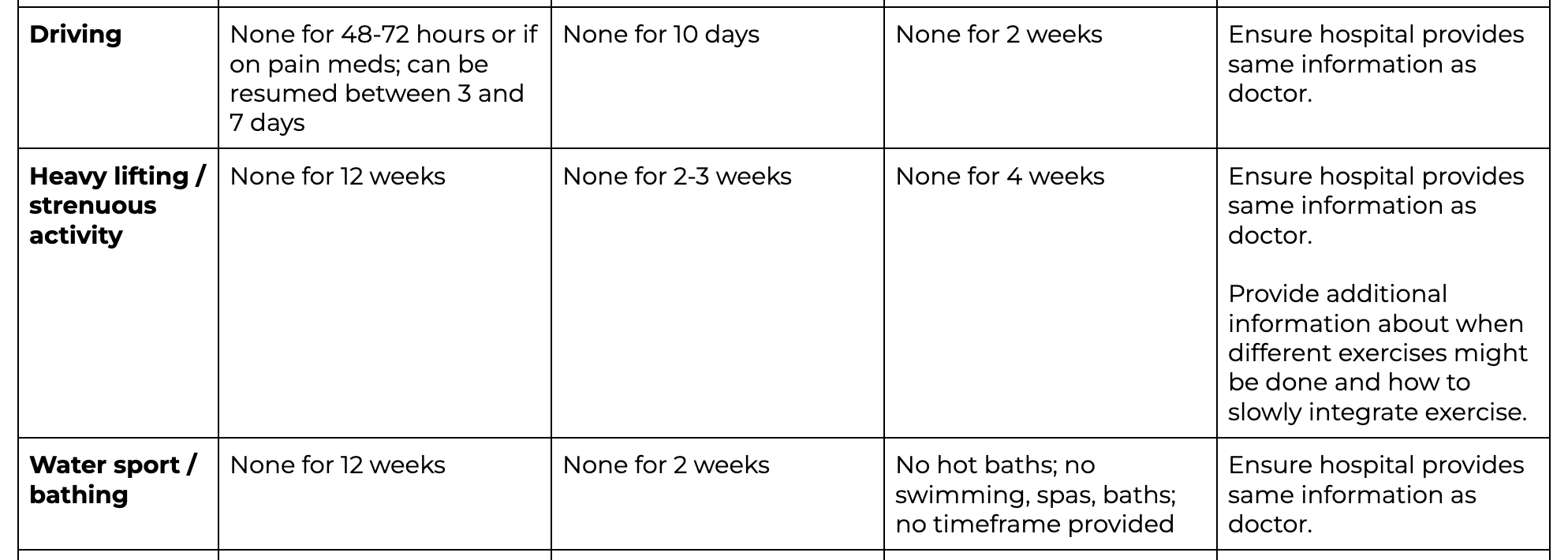
A screenshot of part of a five column table that shows the topic covered in the first column, then the different information for patients in each of the documents relating to that topic in the next three columns, with a recommendation for what to do differently in the documentation.
Some of my recommendations were as simple as ensuring information was consistent and providing information that was important but otherwise only shared verbally, while other recommendations were around format and language choice to ensure it is clear and more easily understood.
What really stood out to me was how simple the fix for much of this was. This is a comparison of written information, which does not have the complexity of sense-making that is achieved dynamically and in situ as it does in conversations. It might take time to review and update, but it’s not complex in the same way that facilitating improvement of conversation is.
I ultimately recommended that only two documents would be provided to patients: one at a pre-operative appointment and one post-operatively which references that pre-operative document noting any changes from that plan only.
The surgeon was unaware that this confusing situation was happening, where patients were being given different documents that contradicted his own recommendations. I had a relatively good experience overall, but this was confusing for me and could be even more problematic for those who may be less familiar with health information and the health system.
Updating discharge information so it is clear and consistent can really help with improving patient experience and providing safer patient care. And of course, Bedside Manners can help you with reviewing and updating your discharge documentation.
-Sarah